Artificial intelligence is here to stay in the daily work of marketers and communicators. It brainstorms, proofreads, and creates visuals for you in seconds. At the same time, important questions arise regarding content ownership, data security, and the boundaries set by the European Union's Artificial Intelligence Act (EU AI Act).
The EU AI Act and its transparency obligations, which entered into force in August 2026, apply to every professional using generative AI in their work. Fortunately, you don't need to memorize legal clauses by heart. Here are practical tips on how to account for EU regulations and use AI content safely.
1. Know the Limits of Copyright
AI speeds up routine tasks for marketers and communicators. One team member generates newsletter headlines, another creates social media images, and a third drafts press releases. When work flows effortlessly and material is produced quickly, copyright matters can easily slip your mind.
Keep at least these ground rules in mind regarding AI content copyright:
- AI-generated output does not hold copyright protection. Neither you, the AI developer, nor the AI itself owns the copyright to generated text or images. Under copyright law, protection only arises from human creative effort—simply providing instructions, or prompting, is not enough to grant copyright.
- Copyright arises when there is a human touch. When you edit, combine, and significantly refine AI-generated material through your own creative choices, the final output can gain copyright protection. Crucially, it comes down to who makes the final creative decisions.
- Be open about what AI was used for and how. The EU AI Act requires transparency in AI usage. When you produce content openly and distinguish between AI assistance and your own creative input, content ownership and copyright protection remain clear.
2. Label AI Content Correctly
The labeling requirements of the EU AI Act apply to all organizations regardless of size. The core obligation is simple: the audience has the right to know when they are reading, watching, or listening to AI-generated content. The Act's labeling obligations apply to AI content published after August 2, 2026. The method of labeling depends on the media format in question.
Text
When it comes to text content, the EU AI Act is more permissive. You do not need to disclose AI usage when using it for proofreading, brainstorming, or refining text structure. However, if you publish news-like content generated entirely by AI to a wide audience, you must disclose the role of AI.
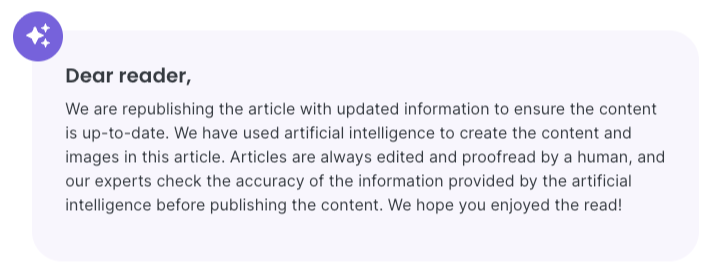
At Liana, data responsibility and transparency are core values. That is why we have chosen to openly disclose AI usage, for instance, at the end of our blog posts.
Images, Videos, and Audio Files
For AI-generated or edited images, videos, and audio content, labeling requirements are stricter. The AI Act mandates labeling all content that resembles authentic material. If the content is obviously fictional or artistic, labeling is not strictly required, but transparency is still a best practice to avoid misunderstandings.
The European Union has developed its own AI icons, the use of which is voluntary but recommended. The icons come in three different categories depending on how extensive the role of AI has been:
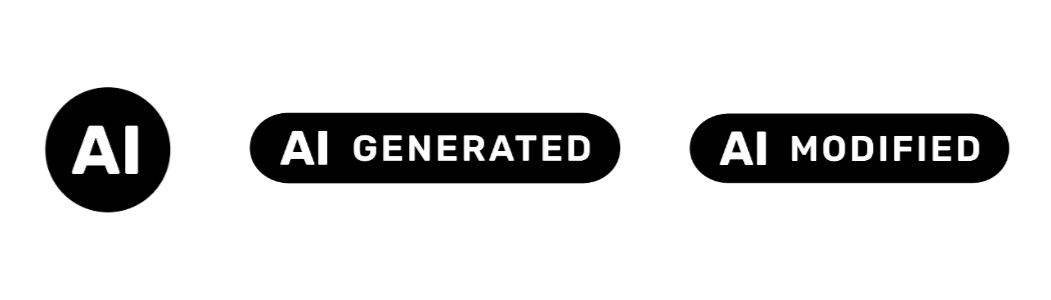
European Union icons for marking AI content. You can download the files here.
If you cannot or prefer not to use the EU's official icons, you can also indicate AI usage through other means:
- Add clear text near the content, such as "Image generated with AI".
- Utilize technical standards, such as C2PA metadata or digital watermarks, which store information about AI usage directly within the file.
The most important thing is to ensure that the label is clear, distinct, and remains attached even if the content is downloaded or reshared across other channels.
3. Verify Usage Rights Before Publishing
Although AI output lacks copyright protection, that does not mean it can be used without any restrictions. Rather than legal copyright, it is a matter of the usage rights (licenses) granted by the service provider—meaning what the AI application’s terms of service allow you to do with the generated material.
Because terms of service vary by tool, selecting the right AI software plays a crucial role. Not all applications found online are suitable for professional organizational use.
Verify these three things before adopting a tool and publishing content:
- Check the commercial usage rights of content generated in the tool. Not all AI tools permit the use of generated images or text for commercial marketing. You are also responsible for ensuring that an AI-generated image does not closely resemble another brand's protected trademark.
- Find out where your input data goes. Open and free AI services may use your text drafts, trade secrets, or personal data to train their public models. At worst, confidential information could end up in answers provided to other users.
- Choose a GDPR-compliant and secure tool. Ensure that the AI tool you use complies with the EU General Data Protection Regulation (GDPR) and that your input data is processed securely.
4. Liana's AI tool Ailu Keeps Your Data Safe
How can you use AI effectively in your daily work without worrying about data security risks or license disputes?
The most effortless solution is to choose an AI assistant built specifically for professional marketing and communications use. Ailu was designed to meet the strictest data responsibility and security requirements.
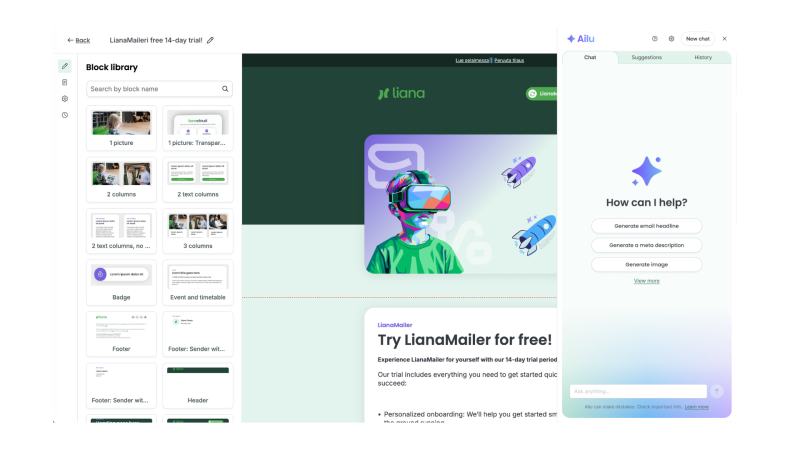
Liana's own AI assistant, Ailu, is built directly into Liana's products.
Ailu's intelligence is backed by the MAISA project, funded by Business Finland. This co-innovation project involved LUT University, Tampere University's GPT Lab, and independent cybersecurity experts from Eficode.
- Your data stays in Finland and the EU: All input data remains securely stored on servers within the EU. Your input data or customer information is never used to train public AI models. The system's data security has been independently audited, and Liana's information security management system is ISO/IEC 27001 certified.
- Seamlessly built into Liana's products: You can generate text and images directly where you already work. Ailu is easily accessible from the top bar of our tools and remembers your chat history as you move between products.
- Smart features for daily work: You can upload files or URL links for Ailu to read as context for your prompts. You can also utilize pre-built templates for common marketing and PR tasks.
- Personalized for your brand: Ailu can be configured with your organization's brand guidelines, tone of voice, product details, and vocabulary. Generated text and images will always align with your brand, requiring less manual editing.
- Free for Liana customers: Ailu is included in our monthly product subscription at no extra cost. No add-ons or installations are needed—it is ready to use right away.
Liana’s proprietary AI tool was developed from the ground up to meet the highest standards of data responsibility and ethical AI. Read more about Ailu's data responsibility and security.
Ready to Harness AI Safely?
At its best, using AI in marketing and PR makes work fun, fast, and efficient—provided the framework and data security are in order. With reliable tools at your disposal, you can focus on what matters most: creating impactful content.
Learn more about Ailu's AI features or get in touch with us—we'll gladly show you how to create high-quality, brand-aligned, and secure content in your daily work!